Value Added
In addition to the extensive variety of plating and finishing options we offer at Alexandria Metal Finishers, we provide numerous value added services. Value added services include pre-plating and post-plating treatment as well as comprehensive nondestructive testing. For customers developing a new design or investigating the modification of an existing part, our experts offer consulting services designed to optimize part life and performance while minimizing costs. There are a myriad of plating and finishing treatment options available, and the fact that an existing treatment is doing an acceptable job does not necessarily mean that the optimal coating is being used. It may be possible to improve part life or reduce costs selecting a new finishing process.
Pre-plating treatment options include alkaline cleaning, abrasive plating, and a number of undercoat treatments such as anodizing or chromate conversion coatings. This ensures that maximum adhesion to the substrate is achieved. Post-plating processes include etching and testing. Multiple types of mechanical and chemical testing equipment can be used to verify coating thickness. Salt spray and humidity chambers can be used to verify corrosion resistance to all applicable Mil-Spec and commercial quality standards. Additional material testing capabilities include hardness, abrasion resistance, and surface profile testing and inspection. All of these services are backed by over 60 years of industry experience and our ISO 9001 quality certification. Check out some of our Value Added Services:
Precision Masking
At Alexandria Metal Finishers, we excel in the art of precision masking in the metal finishing industry. Our skilled technicians employ cutting-edge techniques and technology to protect critical surfaces during the finishing process. With unwavering attention to detail, we ensure that your components emerge flawlessly finished, free from unwanted imperfections. Trust us for unparalleled precision, reliability, and a commitment to delivering the highest quality results in the industry.
Pickup and delivery
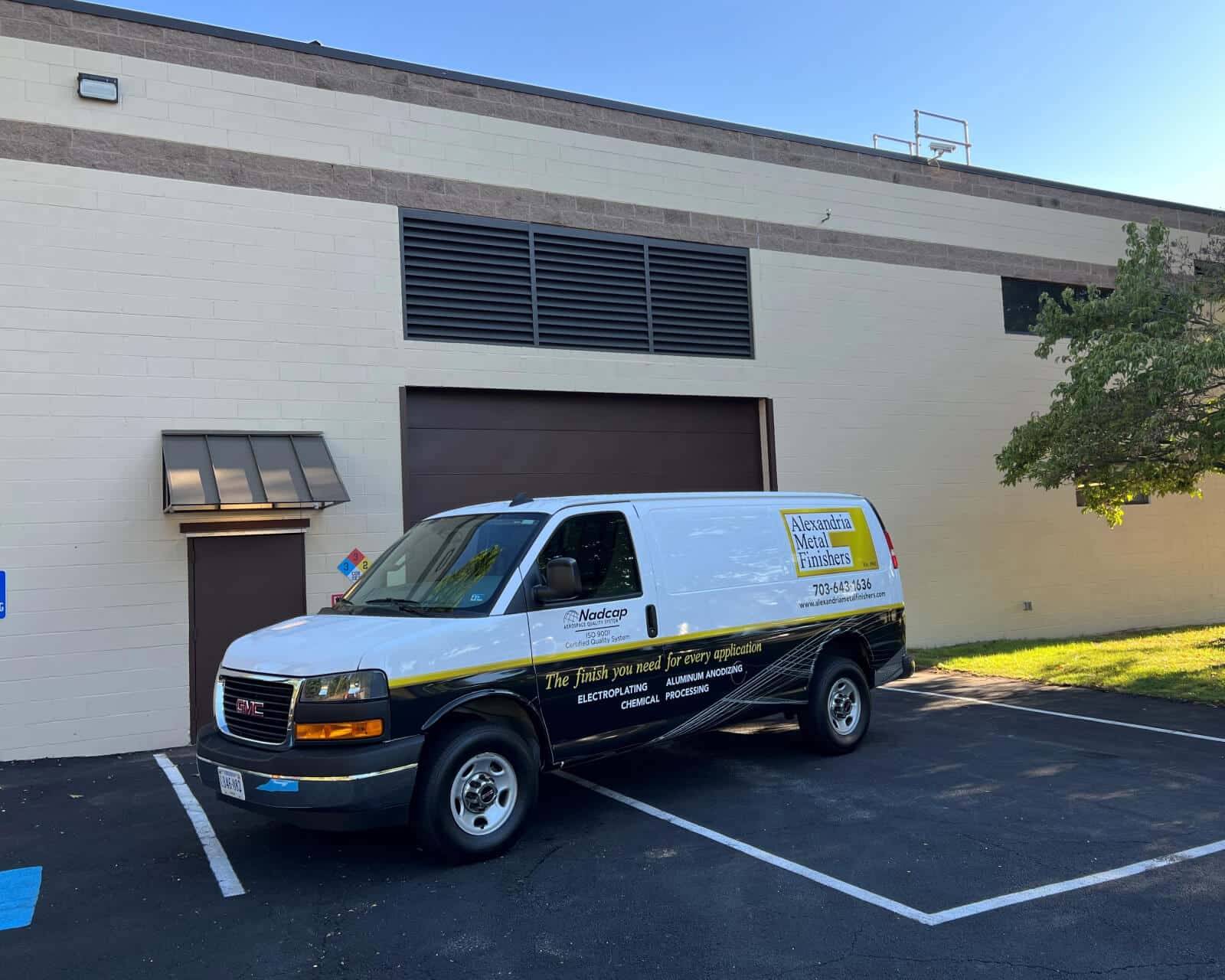
Pickup and delivery available in the DMV area.
Chemical Films
MIL-DTL-5541
MIL-C-5541
These coatings are typically used on aluminum in preparation for a painting or powder coating operation. These coatings promote adhesion between the base aluminum and liquid based media. Chemical films can also be used as a corrosion preventative film for electrical and electronic applications, where low resistance contacts are required. The color can vary from colorless to gold/brown or even iridescent.
Electropolishing
NO MIL SPEC
Electropolishing is a process which electrolytically removes or diminishes scratches, burrs and unwanted edges from most 300 series stainless steel alloys. Finishes from satin to mirror-bright are produced by controlling time, temperature, or both. Electropolishing is useful in that it can be applied to parts with complex geometry. Electropolishing is also commonly applied to the preparation of thin metals because unlike conventional polishing and grinding will not induce the same type of mechanical stresses. Here at Alexandria Metal Finishers we have the ability to polish the interior surfaces of more complicated parts, please contact us for more information on this process.
Passivation
AMS-QQ-P-35
SAE-AMS-2700
ASTM-A967
ASTM A380
QQ-P-35
When a part is machined, various particles may be embedded in the surface of the base metal, weakening its resistance to corrosion and making the part more vulnerable to environmental factors. Debris, dirt and other residue such as free iron, grease and machining oils all affect the strength of the natural surface and can become trapped in the surface during the machining process. These usually go unseen to the human eye but are often the cause of deterioration. Passivation is a process designed to remove foreign metals from the surface of stainless and corrosion resistant steels and promote natural tendency of surface oxidation. Passivation does not change the appearance of the base metal so some of the most effective ways of testing often involves high humidity or saline environments.